
“Table tennis benefits both mind and body, regardless of age,” says 73-year-old Wang Qi, the oldest competitor at the Table Tennis Team World Championships in London. Representing Fiji but originally from China, Wang is 61 years older than the youngest player, Enya Hu of Switzerland. Age clearly poses no barrier in this ever-growing sport.
Wang and Hu are among 380 men and women representing their countries at the Copperbox and Wembley Arenas, where players display remarkable reflexes and skill. This year’s tournament marks a century since the first world championships, and the sport enjoys renewed global attention, boosted by the Hollywood film “Marty Supreme” starring Timothée Chalamet.
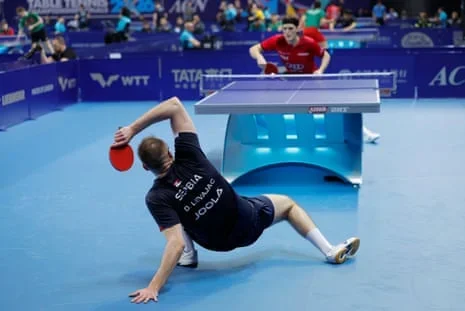
Dimitrije Levajac of Serbia plays a defensive shot during his victory over Luka Mladenovic of Luxembourg in the early round-robin stages at the Copper Box Arena. All 12 tables are in action simultaneously during the early rounds. Jakub Zelinka of Slovakia serves to an opponent from Guatemala.
Tin-tin Ho, England’s top female player, waits for a serve from Hina Hayata of Japan at Wembley. Ho has an older brother named Ping, and her table tennis-obsessed father initially wanted to name her Pong, until her mother intervened.
Lin Shidong of China uses a towel during his win over South Korea’s Kim Jangwon. Dina Meshref of Egypt serves during her victory over Lilou Massart of Belgium. Iulian Chrita of Romania prepares to serve, defeating Farouk Salifou of Benin. South Korea’s Oh Jun-sung is pictured during his victory over Liang Jingkun of China.
Table tennis has evolved significantly from its early days as a Victorian parlor game played on dining tables with cork balls and a row of books as a net. As Boris Johnson joked during the 2008 Olympic handover in Beijing for the 2012 London Games: “Other nations looked at a dining table and saw an opportunity to have dinner; we looked at it and saw an opportunity to play ‘whiff-whaff.’”
Following technological improvements like the adoption of plastic balls, the International Table Tennis Federation (ITTF) was founded by Ivor Montagu, later exposed as a communist spy. The first world championships were held in 1926 at the now-demolished Congregational Memorial Hall in London. The six-day event featured players from nine countries, with Hungary claiming all men’s and women’s titles. Three years later, Englishman Fred Perry, later famous for lawn tennis, became the men’s singles table tennis champion.
The sport has become a global phenomenon with 227 member associations and ranks among the top 10 sports for participation. ITTF President Petra Sörling attributes the game’s universal appeal to its simplicity: “All you need is a table, two bats, and a ball. The cost of entry is low, rules are simple, and you can play indoors or outdoors, in any climate or culture. That’s why, here in London and around the world, you see people playing in sports centers, parks, offices, and town halls – anywhere you can fit a table. It truly is a sport for all.”
A 1901 illustration shows members of high society playing whiff-whaff on a dining table. Competitors at the 1926 World Table Tennis Championships at the Congregational Memorial Hall in Farringdon, London.